We've been hearing the same doom-mongering forecast for months: artificial intelligence is going to replace programmers. However, data from the US job market shows the exact opposite. Job postings for software developers are not only not falling, but they continue to rise.
How can this apparent contradiction be explained? Probably because the volume of code that needs to be produced, maintained and audited is increasing radically.
The amount of deployed software has never been so large. Code repositories on major collaborative platforms are experiencing exponential growth. When you look at recent metrics, the curve of new project creation is vertical.
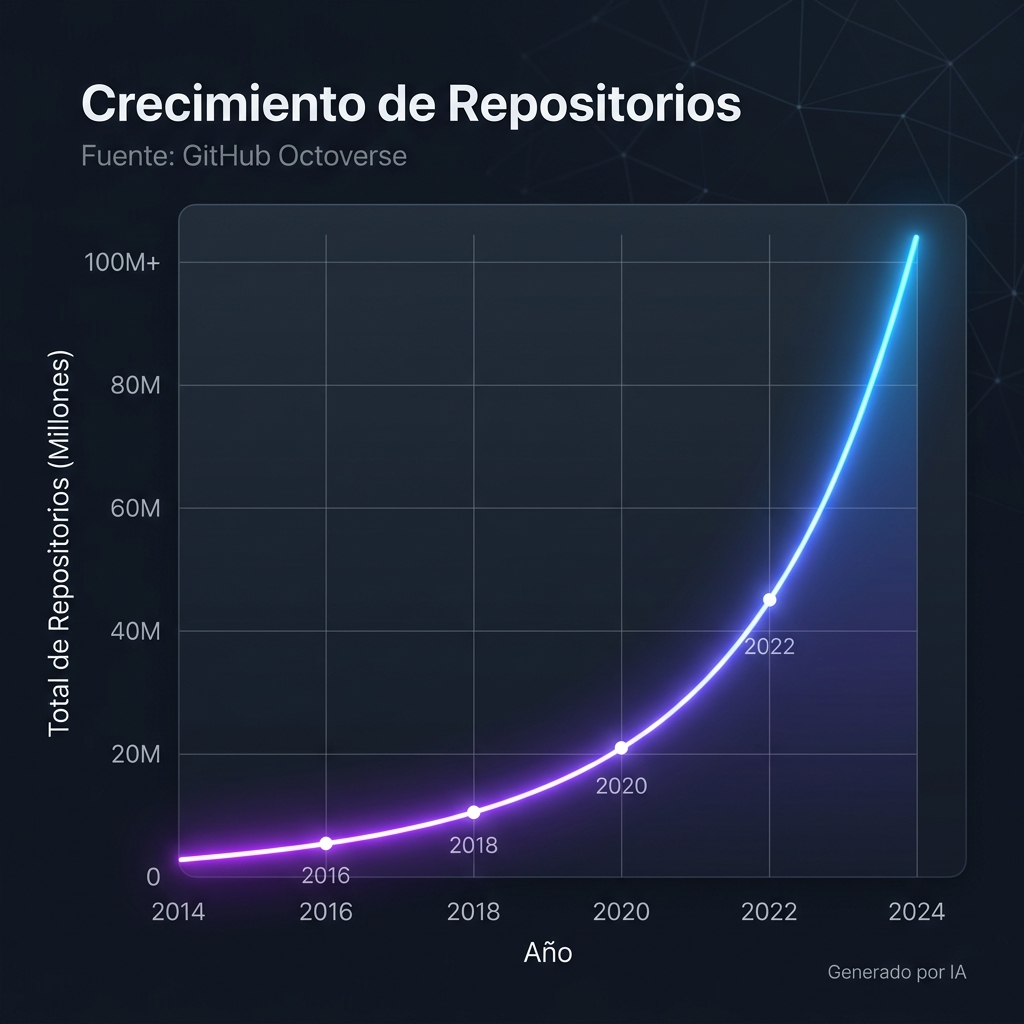
Source: Data based on the annual GitHub Octoverse report on the growth of the open-source and corporate ecosystem.
The key to understanding this phenomenon is purely economic. By drastically reducing the cost and initial friction of code production, artificial intelligence has made custom development accessible to a much larger number of companies, sectors and projects.
Business areas that barely three years ago didn't even consider creating their own tools due to lack of budget, are now jumping right into it.
The paradigm shift: from typing code to orchestrating systems
Let's look at a practical example. Imagine an SME in the logistics sector that traditionally operated with shared spreadsheets. Before, commissioning a real-time inventory and route management system cost tens of thousands of euros and required a dedicated development team for months. It was unfeasible.
Today, a single AI-assisted developer (like Copilot or Claude) can spin up the base architecture in a matter of days. They can generate the database schemas, the backend boilerplate in Python and the interface in React with a speed unthinkable a decade ago.
But this is where the developer's work becomes indispensable. Auto-generated code doesn't deploy itself into production. Someone has to:
- Configure the CI/CD pipelines so the deployment doesn't break the live environment.
- Audit the security and performance of the queries generated by the LLM.
- Integrate that system with the shipping provider's legacy API, which probably has outdated documentation that the AI can't figure out.
- Design the cloud architecture so it is resilient.
The manual work of writing for loops decreases, but the cognitive load of how the pieces interact in production multiplies.
More projects, more maintenance, more employment
AI has given us a backhoe instead of a shovel. We haven't run out of work because we can dig faster; we're simply building much larger infrastructures.
With more software projects underway, there is more code to maintain. There is more technical debt to manage, more architectures to migrate and more systems to integrate.
Paradoxically, far from wiping out technical positions, this dynamic of cheapening creation is generating an explosion of demand. This should prompt us to seriously nuance the superficial discourse about massive job destruction heralded by the boom in automation. The role of the developer is not destroyed. It evolves towards systems integration and architecture supervision. And it turns out we need more architects than ever.